

If you are just joining us, here is part 1 of this series.
Talking to users is two hard problems at once. Finding thirty strangers who will talk to you, and not poisoning the conversation once they do.
Part 1 was the setup: you wrote the bet down in one sentence, you named an ICP specific enough to be proven wrong, and you built an interview guide that asks how people work instead of pitching them your idea. That part happens at a desk. This part happens out in the world, where people ignore your messages and tell you your idea is bad. It is harder, it is less comfortable, and it is where most people quit.
Here is how to do it anyway.
Thirty People Is the Target
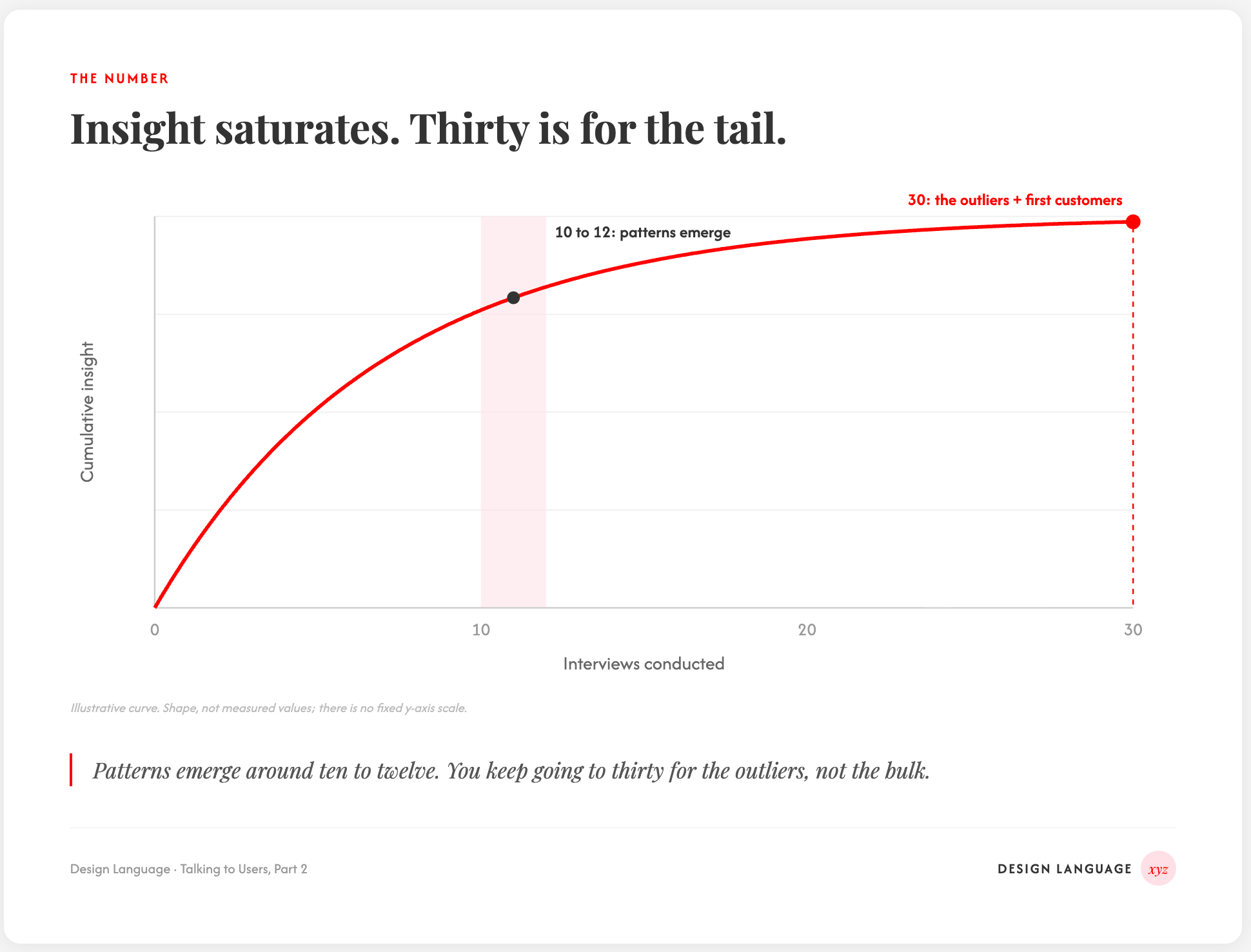
Patterns start repeating around ten to twelve interviews. That is the moment the same complaint shows up for the third time and you realize you are onto something real.
So why keep going to thirty? Because the interviews past that point are where the outliers live, the person on the fringe of your ICP who reframes the whole problem, and because your early interviews double as your first sales pipeline. The people who take your call now are the people most likely to buy later.
Your first few interviews will be rough. Accept that now. You will talk too much, ask leading questions, and forget to dig. That is fine, because this is about reps. You don’t get good at interviewing by reading about it. You get good by being bad at it thirty times. One venture incubator I worked at required me to run a hundred and fifty interviews before building anything, and by the end I could talk about the industry more fluently than the people working in it.
Start With Your Five, But Treat Them as Rehearsal
Your warm network is the fastest place to start and the worst place to trust. Friends and family will talk to you, which makes them perfect for practice and useless for data. Saying your questions out loud is a different skill than writing them, and you want to fumble the wording in a low-stakes room before you burn a hard-won stranger.
So use the easy five, but label them correctly. Warm contacts are a dress rehearsal, not a data set, unless they happen to be dead center in your target market.
Do not anchor on what your friend told you. And end every single conversation, warm or cold, with the one question that compounds: who else should I talk to? That question is how five interviews turn into fifty.
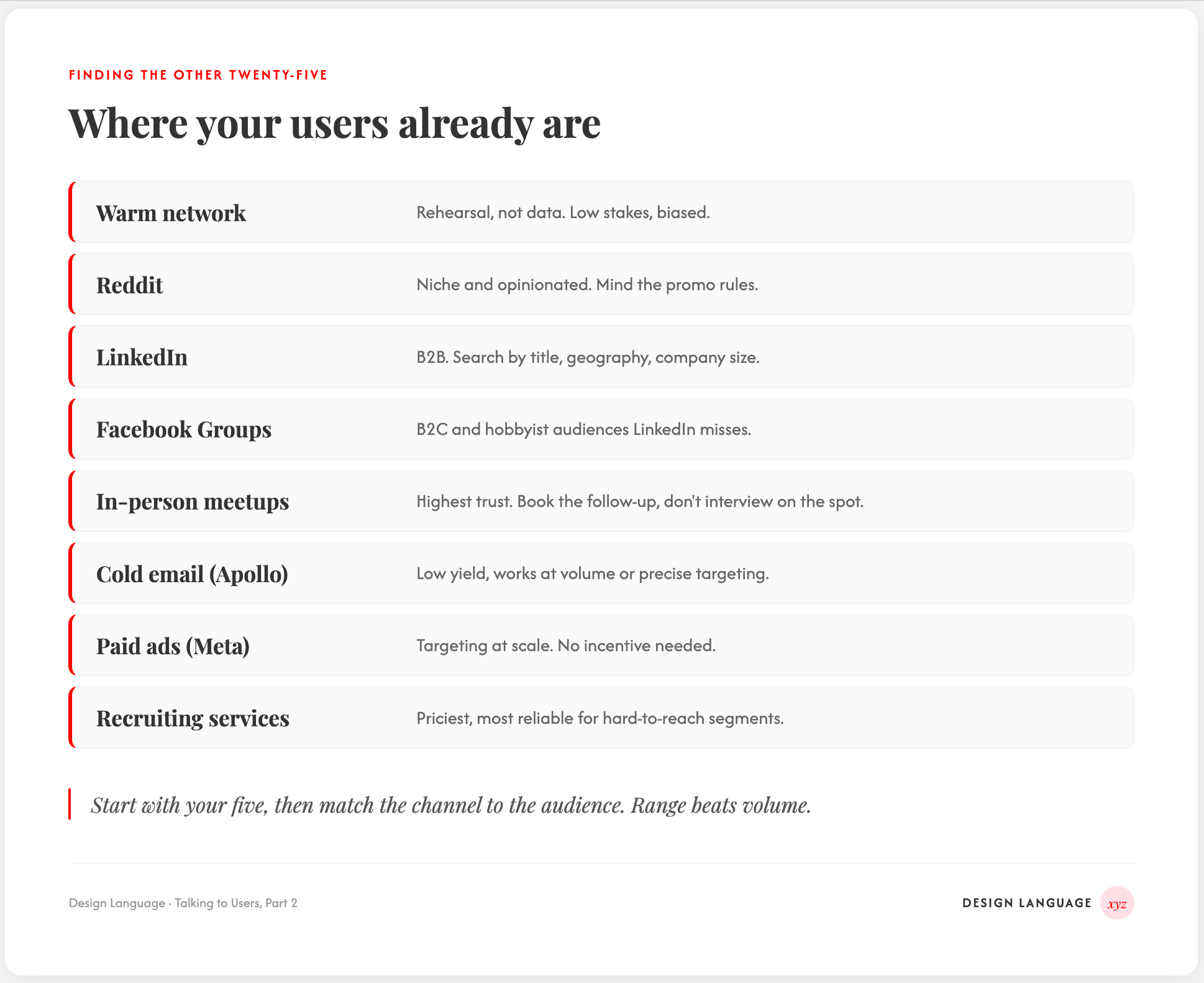
Then Go Where Your Users Already Are
Once the network runs dry, you go to the channels, and each one fits a different kind of user.
Reddit is a room full of opinionated, self-selected people, which is exactly what you want for a niche. Find the subreddit, read the threads where people complain about your problem, and DM them. Watch the rules, because most subs ban promotion and will remove you for it.
LinkedIn is the B2B channel: search by job title, geography, and company size to land on your ICP directly. Messaging is capped unless you pay, so target people with open profiles and lean on shared groups to get around the limit.
Facebook Groups work better for consumer and hobbyist audiences that LinkedIn never touches.
In-person meetups are the highest-trust channel of all. But do not try to interview people on the spot! You show up, ask the organizer for five minutes to introduce what you are working on, walk the room, and book Zoom calls for later.
Cold email is the low-yield workhorse: a tool like Apollo finds the addresses, most people ignore you, and it only pays off at volume or with very precise targeting.
Paid ads on Meta, Reddit, or LinkedIn buy you strangers with real targeting, and here you do not need an incentive, because the targeting is doing the work the gift card would. When you are paying to reach someone, let the targeting be the bribe.
And recruiting services like UserTesting.com are the most expensive and the most reliable, worth it when your ICP is hard to reach or sits behind a wall like HIPAA. Vet the firm, because the cheap ones sell you spam-panel respondents.
Leave Your Ego in the Parking Lot
Now the interview itself, and the first thing to handle is you. You are about to be wrong out loud, in front of a stranger, repeatedly. That is the process.
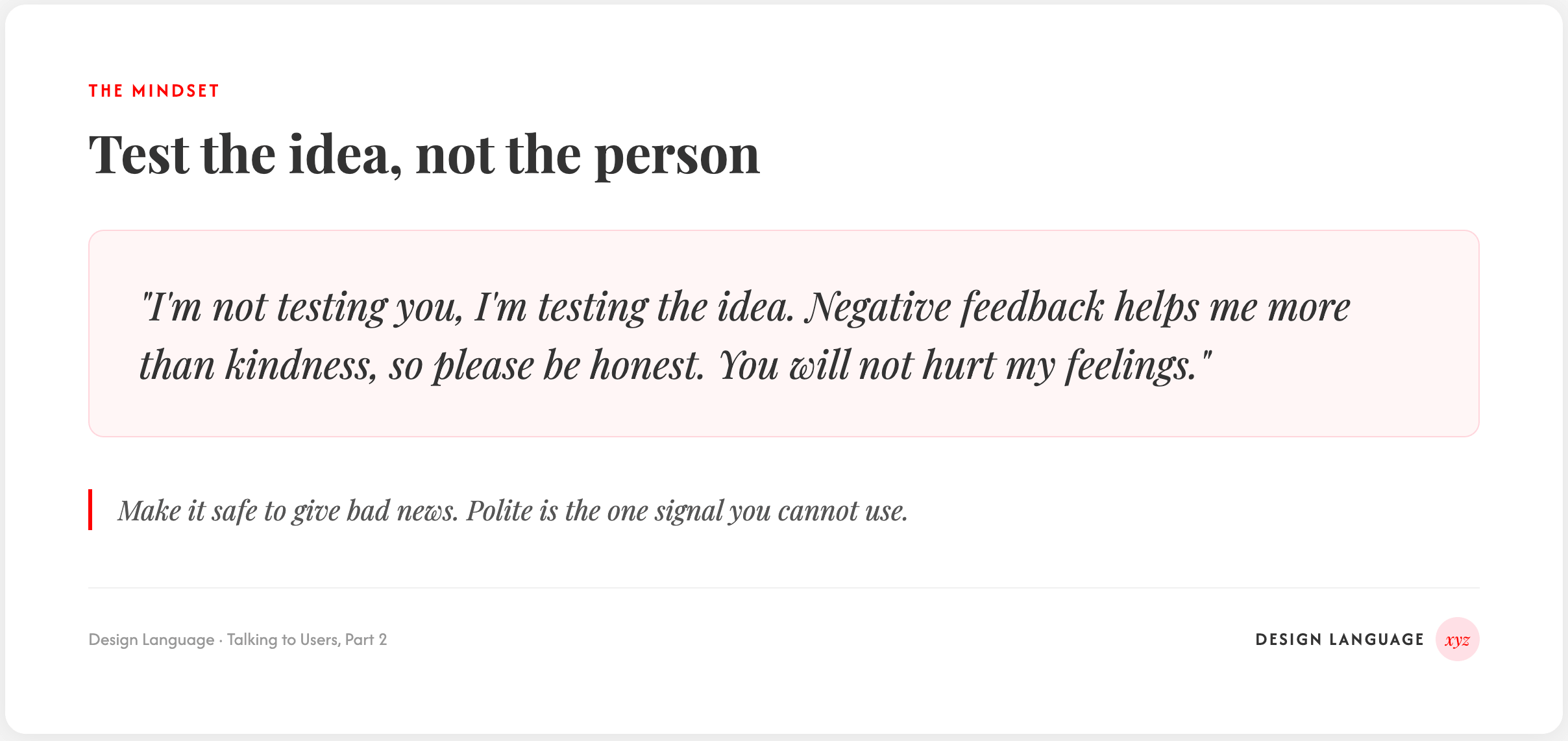
Open by taking the pressure off them: “I’m not testing you, I’m testing the idea.” Make it explicit that negative feedback helps you more than kindness does, because people instinctively soften bad news to be polite, and polite is the one thing you cannot use. Frame their honesty as the thing that saves you months and money. And keep your actual goal in view: you are validating that the problem is real and specific, not that your solution is good.
You are not in the room to hear that your idea is clever. You are there to find out if the problem is even real. The moment you start selling, you stop learning, and you cannot do both in the same call.
Shut Up and Let the Silence Work
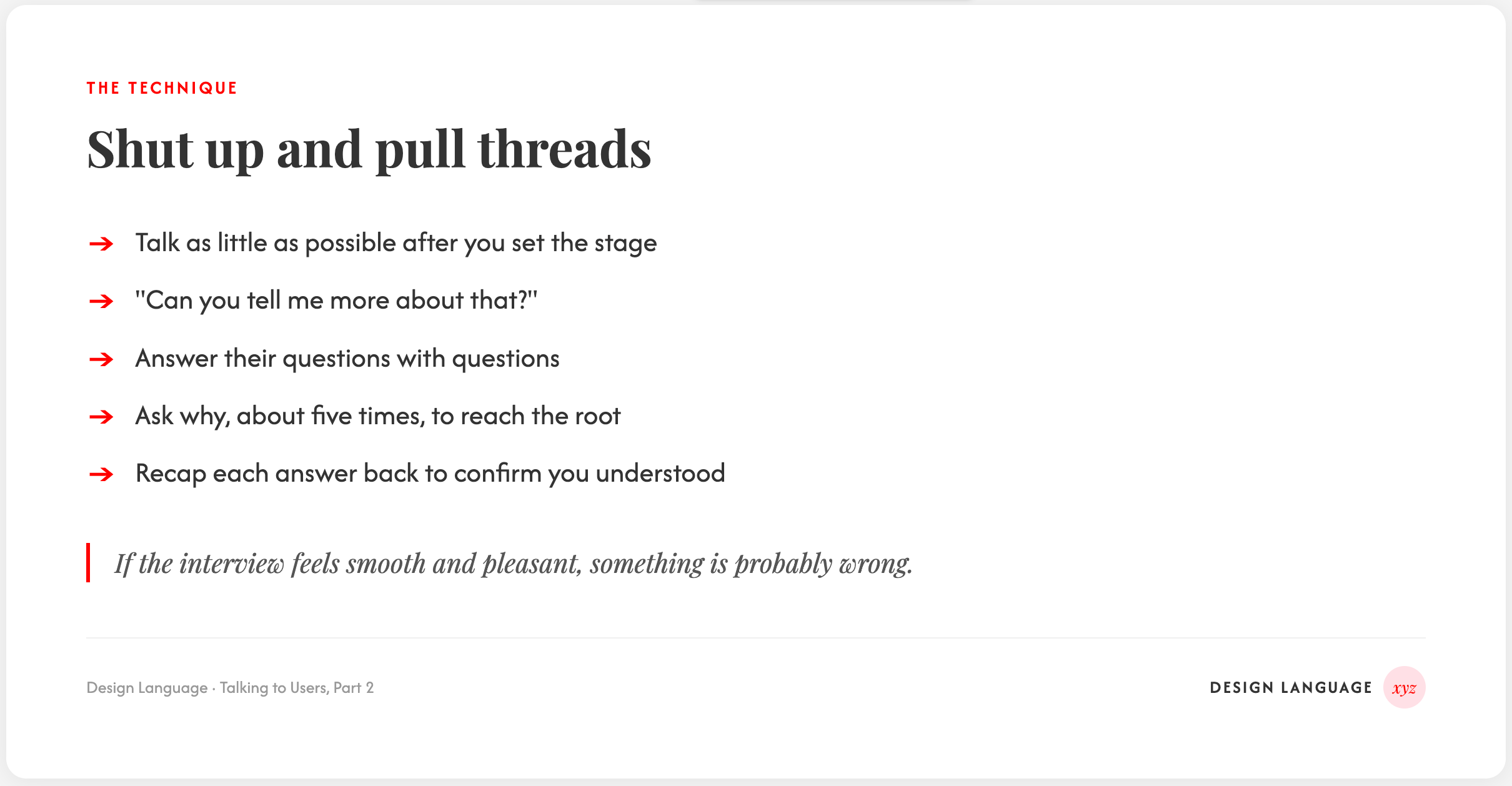
The best interviewers barely talk. Your interview guide is just that - a guide. Once you have set the stage, your job is to get out of the way and let the other person fill the space. When they ask you how something should work, turn it back: “how would you expect it to work?” Their answer is worth ten of yours.
When something interesting surfaces, pull the thread instead of moving on. “Can you tell me more about that?” and “I haven’t heard that before, give me some context” are the whole toolkit. Ask “why” enough times to reach the root, though in a real conversation you frame each why with a little context so it does not feel like a toddler interrogation. At the end of each answer, recap what you heard back to them, and they will either confirm it or correct you, and both are useful.
If the interview feels smooth and pleasant, something is probably wrong. The discomfort is the sound of it working.
Show the Prototype Last, and Know Why You’re Showing It
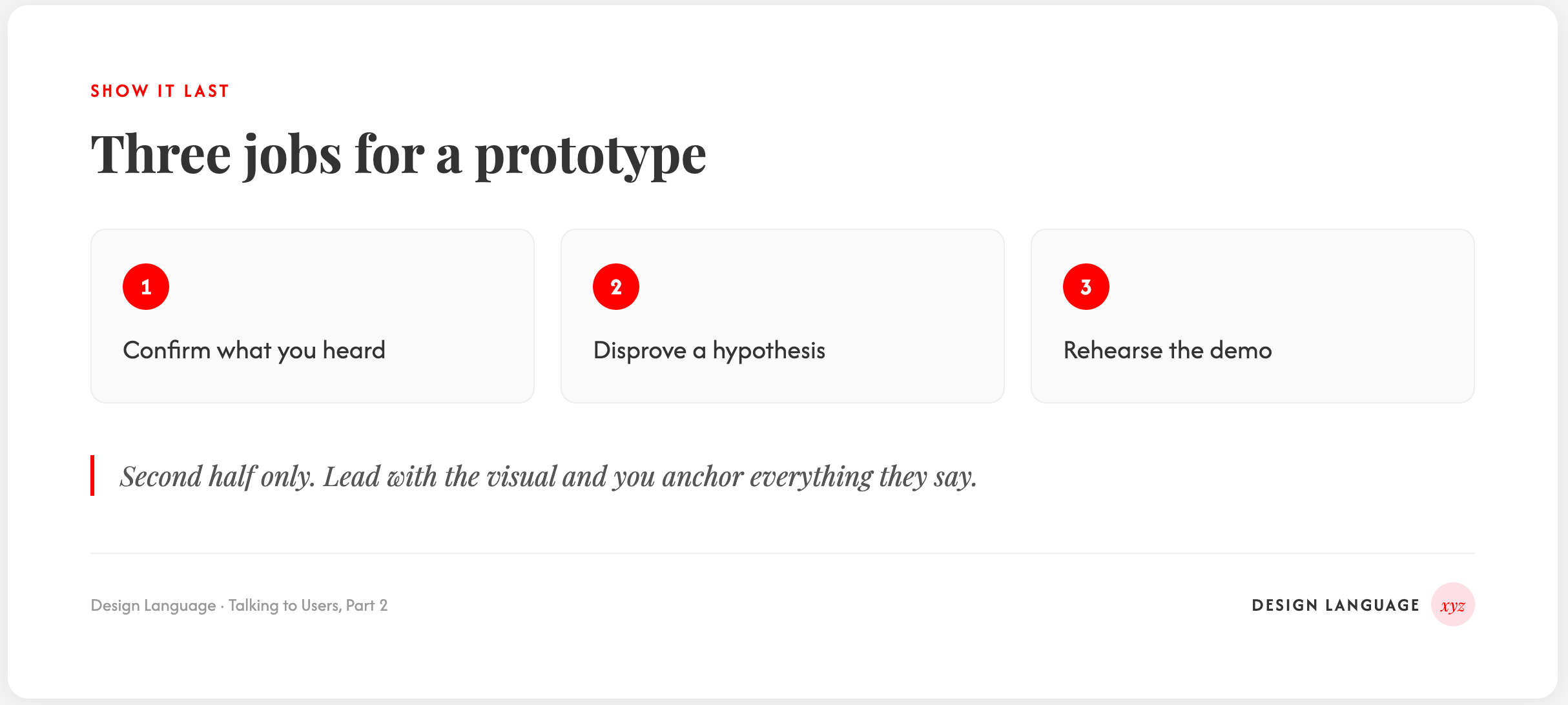
If you have something to show, a mockup or a few slides, it comes out in the second half, never the first. Lead with the visual and you anchor everything they say to your idea. Lead with the conversation and you get their unfiltered view first, then use the prototype to test it.
A visual aid does three jobs. It confirms what you heard, by showing them where the thing they described would live. It disproves a hypothesis, by letting you say “you told me this would not matter, so we cut it,” and watching them react. And it builds your own demo fluency for the day you actually sell.
Beware the One Confident Voice
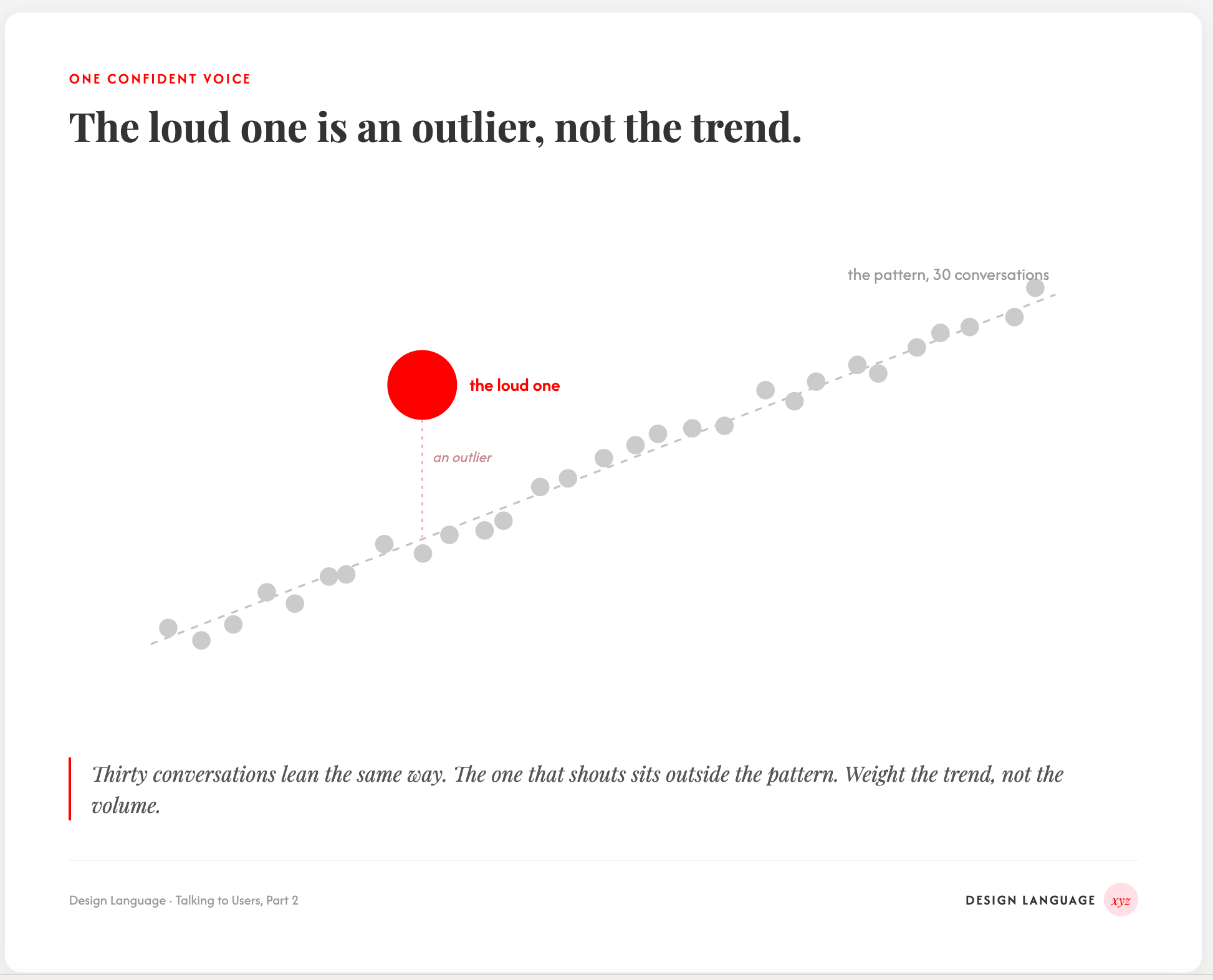
The most dangerous person in your thirty is the loud, certain one. A single confident user is still a single data point, no matter how sure they sound, and their conviction will pull you off course if you let it. Weigh the pattern across all thirty conversations, not the volume of any one. Even the sharpest, most successful operators are wrong plenty of the time. Trust the trend, not the loudest voice in it.
The muscle you build here, cold outreach, finding an audience, telling a clear story under pressure, is the exact same muscle you will need to sell and market the thing later.
The work of finding thirty strangers is first rep of the skill your business will eventually run on.
The Pile Is Worthless Until You Use It
Thirty conversations in, you are holding hours of recordings, notes, and half-formed patterns. That pile does nothing until you turn it into a decision, which is its own discipline and its own piece. For now, the win is simpler: you stopped guessing, and you have real people on record telling you where you are wrong.

Use this today
Write down the thirty people you would need to talk to and where each one comes from: how many from your warm network, how many from a specific subreddit or LinkedIn search, how many from a Facebook group or a local meetup. If you cannot fill the list, finding the gaps is your task this week. Then book the first call.

LLM Prompt
You are a user research recruiting strategist. Here is my ICP and the
problem I am validating: [paste your one-sentence bet and your ICP].

Do the following, in order:
1. Map the best channels to reach this specific ICP, ranked. Consider
   warm network, Reddit, LinkedIn, Facebook Groups, in-person meetups,
   cold email, paid ads, and recruiting services. For each, say why it
   fits or does not fit this audience.
2. For the top three channels, give me a concrete first action this week.
3. Draft a short, non-salesy outreach message I can adapt for each of
   those three channels. It should ask for their expertise, not pitch
   my product.
4. Flag anything about my ICP that will make recruiting hard, and how
   to work around it.

If my ICP is too vague to target, ask me one clarifying question at a
time before continuing.
About Us
Design Language is a newsletter for all product builders (PMs, Engineers, Founders, etc) who want to improve their design literacy, hone their sense of tase, and improve their craft when building products.
Jeremy Belcher is a 15 year product and design veteran. He has designed UX/UI for products used by tens of millions for brands like Google, Salesforce, Saturday Night Live, DirecTV, BMW, Emirates, Visa and in the past several years has focused on new enterprise workflow products. He runs the product studio Robot Heart, which designs, builds, and validates 0 → 1 B2B workflow tools for teams and founders.
David Issa is a digital strategy and product design leader with over 15 years of experience guiding companies through transformation. He has helped scale products and teams across healthcare, fintech, and enterprise software, translating complex systems into human-centered experiences. David runs a strategic design practice focused on aligning purpose, architecture, and execution—bridging design, AI, and organizational strategy to help teams build with clarity and intent.
The “30 is for the tail” framing is the useful part. Most teams stop at 10 because the patterns show up fast and it feels done. But the decisions hide in the outliers past 20, the users who don’t fit the tidy pattern. Cheap to talk to ten. Expensive to skip the last twenty.